Building a Dream - Part One
At this point I was so into game development that I harassed the poor (and patient) people at Polarware Software, not only the developer of TGM but also the publisher of a solid catalog of interactive fiction games. It was free, looked like a lot of fun, and I was really looking for a new hobby. com.
Welcome, to the first installment of a three part series. This blog will focus on a firsthand look from two talented, passionate game developers from polar opposite backgrounds, coming together to create a business and the video game of their dreams. Catch Light Interactive, LLC co-founders Jorgen Tandberg (Norway) and Paul Kardos (USA) talk about what inspired each of them to get into game development.
Meet Paul Kardos, Writer, Artist, Right-Side-of-the-Brain
I wrote my first game in 1985 on an Apple //e (the “e” stands for enhanced!) that had 128kb of memory, a 300bps dial up modem, and dual 5.25 inch floppy drives housed in one large, somewhat heavy and remarkably loud unit.
Ah, those were the days!
I programmed in Basic. Line by line, with all the INPUT, GET, and GOTO commands you’d expect. It was simplistic coding, sure, but programming was exhilarating to me. Dreaming up functionality, writing the code, debugging, and then that pure joy one feels when it all comes together and just…works. Somehow I managed to write my own text parser, which is how old text adventure games worked back then, and began telling stories through my computer.
It wasn't longer before I discovered something called The Graphics Magician by Penguin Software (later Polarware, later defunct.) With this amazing tool, I could draw double “hi-res” images for my text games in stunning 16-bit graphics! I was hooked immediately, drawing trees, mushrooms, castles, bushes, characters, and whatever else I could dream up. Eventually I got tired of drawing with a mouse and ran out to buy my first drawing tablet. It was nothing like the tablets we have now, but at the time it was a massive step forward.
The ingenious thing behind The Graphics Magician was how it worked. Storage space was an issue back then, with those floppy drives only capable of holding 140KB of data. Instead of using valuable disk space to save a complete image, the Graphics Magician simply stored the steps used to create it. When called by your program, the image was drawn by following those same steps until the complete image appeared on the screen. This process even allowed for some really early, really crude animations.
I know. It doesn’t sound like much now, but it was pretty cool at the time.
At this point I was so into game development that I harassed the poor (and patient) people at Polarware Software, not only the developer of TGM but also the publisher of a solid catalog of interactive fiction games. They ended up sending me a copy of their in-house version of The Graphics Magician along with some kind words on how to go about creating a commercial game for sale. Probably all they could think to do to shut me up.
With this new tool at my disposal, I could feel the difference right away. My graphics were better, my stories became more complex, and my coding skills improved. I was getting somewhere, getting close to finishing my first game!
And then one day, I just stopped. Know the feeling?
I don’t remember why I quit. I think that just happens, especially at the age when you’re trying to figure out who you are and what you want to do with your life. I discovered other interests, ended up moving away to college, started a career, and raised a family. You know the story.
Fast forward to January, 2020. Although I stopped developing games, I never stopped playing them. They remain a great source of entertainment and a way to relax. On a whim, I decided to look into Unreal Engine 4. It was free, looked like a lot of fun, and I was really looking for a new hobby. My programming skills remained where I left off some 30 years before, so UE4's Visual Scripting was really helpful. I didn’t know C++, but I could figure out blueprints. UE4 is also known for being very artist-friendly, and 3D art was something I really wanted to get into.
 My Blender Doughnut. I called it Genuine Blender Doughnut with Default Cube Sprinkles and a Limited Edition Suzanne Coffee Cup. A bit wordy, I know.
After watching a few tutorials, I decided to create my first game. An homage of sorts to the novel The Long Dark Tea Time of the Soul by Douglas Adams. You might know him better for his Hitchhiker’s Guide to the Galaxy series, but his Dirk Gently books are really clever, as well.
In the book, one of the characters is walking down the street alone at night. Every time she steps under a street lamp the light bulb pops, leaving her standing alone in the dark. Adams does a far better job of describing how unsettling that feels than I ever could, but you get the idea. Eventually, she reaches her apartment only to find a new Coca-Cola machine next to her apartment's front door, and then Thor (yeah, that Thor) shows up and gets into a fight with an eagle.
Maybe you should just go read the book.
Anyway, my idea was to create a first person game where – you guessed it – the player walks down a street at night and the lights pop off every time you pass under them. At the end of the “game”, there’s a Coke machine waiting and when you get close enough a screeching eagle sound plays.
Not much of a game, I know. At least I learned a lot about box triggers.
The bright side is that I was hooked on game development all over again! Figuring out how to make things work in the engine was a thrill and revitalized my passion. It was also responsible for my start as a 3D artist. I remember spending countless hours trying to find free 3D street light assets in .fbx format (whatever the hell that meant) and coming up frustratingly short. It finally occurred to me that maybe would be easier to figure out how to make my own streetlight instead.
That’s when I discovered Blender.
I deleted my first default cube and made my obligatory Blender doughnut. Then I made an anvil and a cloudy planet Earth. Feeling brave, I decided to leave the safety of my tutorial nest and modeled my Fender Jazz Bass. When that turned out pretty good, I became consumed with Blender, spending 10-12 hours a day, seven days a week modeling everything and anything I could think of. That’s the amazing thing about the artistic tools we use to develop games. If you can think of it, you can model it. I was hooked.
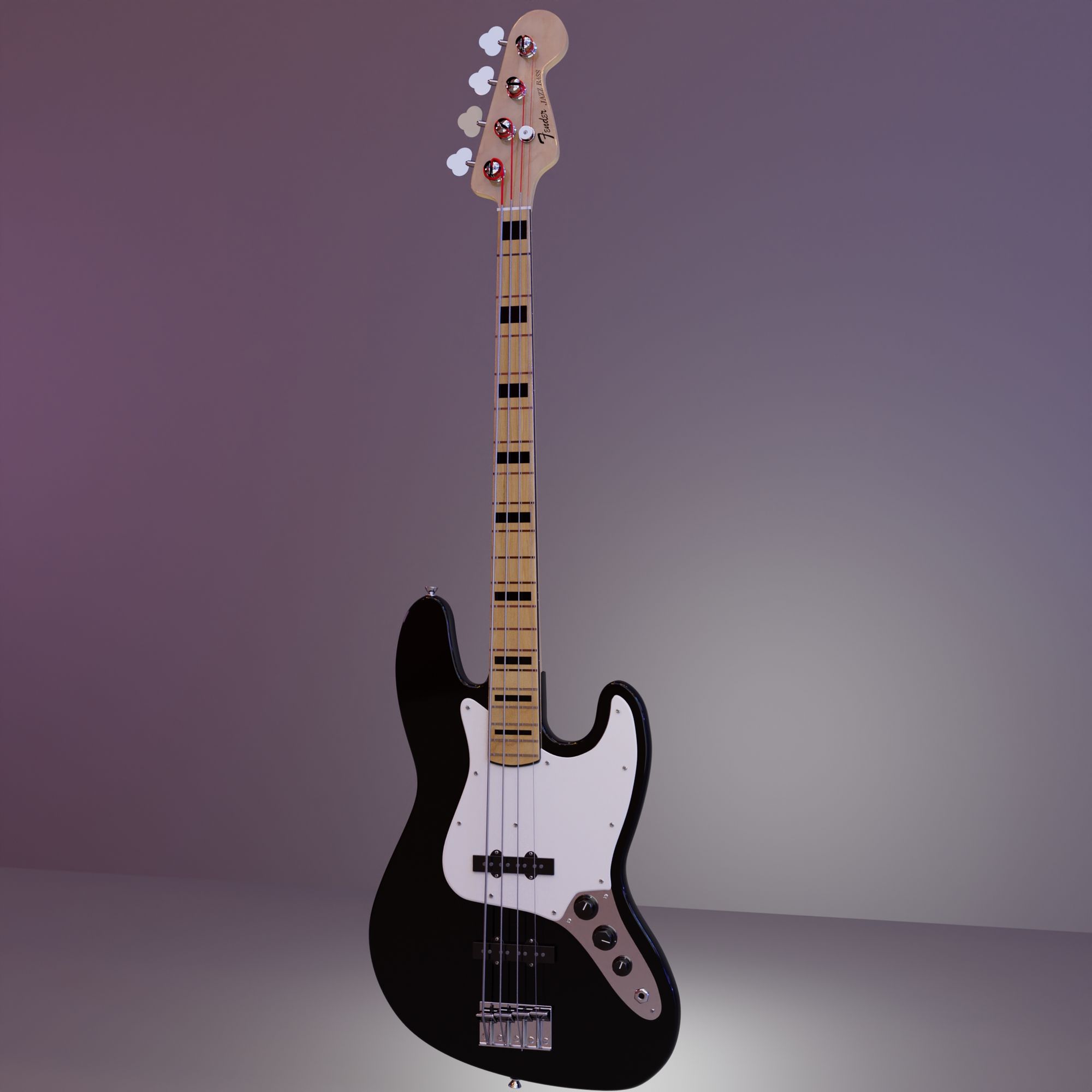 Cycles render of my beloved Geddy Lee Signature Fender Jazz Bass, circa February 2020.
I fell in love with creating photorealistic renders, experimenting with particles and short animations, and trying my hand at organic sculpting. It was then that I found all kinds of Discord servers dedicated to game development. And one of those servers – hosted by GameDev.tv’s amazing instructor, Grant Abbitt - just happened to have a collaboration/meet-up channel.
I came across an ad from a small startup studio looking for “beginner to intermediate” artists who could produce 3D assets. I was pretty green as a 3D artist, but I wanted to learn what it was like working in a collaborative environment. I might have a lot to learn yet, but I was confident I could contribute something of value to the team. Besides, what artist doesn't want their work to be seen?
I applied, somehow they said yes, and I got to work right away. I created hundreds of assets for the studio's mobile arena game. I was designated as the lead artist very early on, leading a team of other fledgling, talented artists from all over the world. What an experience! I made friends with some really great people, and learned a lot about game development during my time there.
Unfortunately, I also felt the game wasn’t going anywhere.
It was a cool idea, but we lacked organization. There were too many contributors coming in and out through a revolving door. We also didn’t have a GDD, so a lot of things got mixed together into a less-than-coherent jumble of loosely scattered ideas. The experience exposed me to new techniques, source control tools, Trello, and, most importantly, other people like me. But it lacked the culture and environment of a business-minded organization that I was accustomed to. Game development, after all, is a business.
Eventually, the game just fizzled out. It happens. On the bright side, I met my business partner, Jorgen Tandberg, who was the Lead Developer of the project. That alone made the experience worth it. We found that we had complimentary skills and got along really well. He is a programmer, the logical, left-side brain of our partnership, while I have the more creative side, the artist and writer.
Together, we are absolutely better game developers.
We decided to work together on a game concept I had, a title called Project: New Light City. It’s a narrative-driven third-person psychological thriller. I had a few interesting characters from the first draft of a novel I wrote whose stories, as it turned out, are better told in a game. My fascination with technology, how it advances over the years (usually not quite as we hoped and dreamed but amazing nonetheless) also came into play. I don't like to make comparisons. Project: New Light City is like Project: New Light City, you know? But you could say I was heavily influenced by titles like Detroit: Become Human, Sherlock Holmes: Crimes and Punishments, and, more recently, The Medium.
 Downtown New Light City.
Admittedly, Project: New Light City is a highly ambitious project.
We both like a challenge, though, so Jorgen and I decided to start our own indie studio. Only this time, we would treat it like a business. Organized, structured, everything done with a plan in mind, everything done by design. We agreed that we would form a legal entity, operate as equal partners, and either we both agreed to do something or it didn’t happen. That was how we would insure longevity as business partners.
Our plan was to legitimize Catch Light Interactive as a legal entity, and then build a working prototype of our game. A demo of our concept to show potential contributors and investors that we were serious about developing a game and bringing it to the market. It would also help us identify the right tools and resources we should use to see our game through to the end. And to start building a foundation of key contributors to help build our game and the future of the studio.
Sounds good on paper, right? We thought so, too. Ah, the best laid schemes o’ Mice an’ Men...
Thank you for reading part one of this blog series. We hope to see you return for the second part of the series which revolves around the left side of the brain, Jorgen Tandberg. See you then!
Catch Light Interactive, LLC was founded by Jorgen Tandberg and Paul Kardos. They recently finished a demo of their interactive thriller, Project: New Light City. For more information and breaking news about the game and Catch Light Interactive, LLC, please visit: www.catchlightinteractive.com. You can also follow the studio on Twitter, Discord, Instagram, YouTube, or your favorite social media platform.


